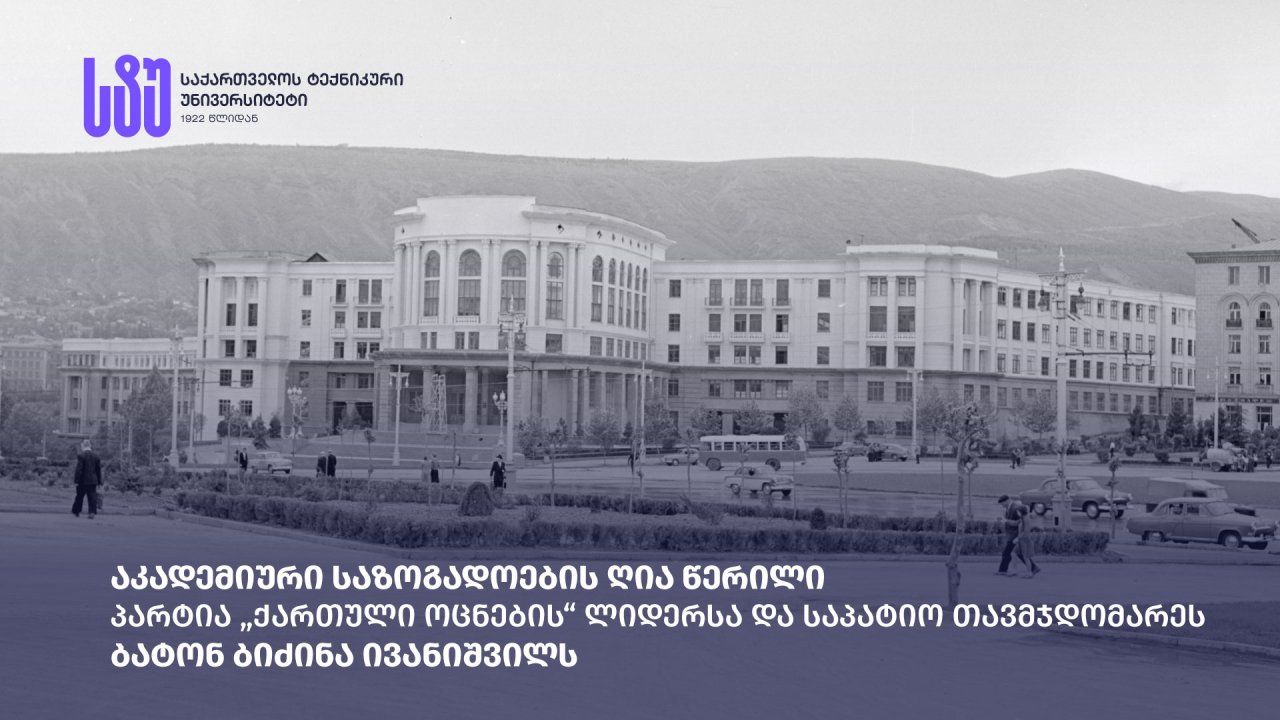

GTU Professors’, Researchers’ and Students’ Petition Demanding the Suspension of the University Merger
To the Prime Minister of Georgia, Mr. Irakli Kobakhidze
To the Chairman of the Parliament of Georgia, Mr. Shalva Papuashvili
To the Minister of Education, Science and Youth of Georgia, Mr. Givi Mikanadze
We, the professors, scientists, researchers, students, alumni, and individuals concerned with the educational process at Georgian Technical University (GTU), express our deep concern regarding the potential merger of GTU and Tbilisi State University (TSU).
GTU, with its 104-year history, represents the foundation of Georgian technical and engineering education. Its establishment is associated with the names of distinguished Georgian scientists and public figures, such as Ivane Javakhishvili, Niko Nikoladze, Nikoloz Muskhelishvili, Andrea Razmadze, Alexandre Didebulize, Giorgi Nikoladze, and many others, whose vision called for the development of national technical education as a separate institution.
Following the country’s independence, GTU was established as a universal teaching and research institution. The university played a decisive role in the development of the country’s industrial, energy, transport, and infrastructure sectors. Considering its century-long history, GTU may also be regarded as a monument of Georgia’s cultural heritage—the only temple of engineering and technological knowledge in Georgia. GTU’s century-long contribution was recognized by the global community and celebrated under the auspices of UNESCO. The great Ilia Chavchavadze once said: “If a country has 12 educated engineers, it will develop faster and more sustainably than with people who only think in words.” GTU has produced not just 12, but over half a million professional engineers throughout its 104-year history, building and establishing this country. Neither our history, nor our present, nor our future deserves such treatment. We cannot be the generation that allowed the destruction of the temple of knowledge and the regression of our country by 100 years, into a rootless, futureless Georgia.
Without any argument, discussion, or debate, the artificial merger of the largest universities will not result in improved rankings or development for either institution within Georgia or beyond. Instead, it will create unmanageable administrative processes, hinder healthy competition, lower the quality of education, and restrict students’ freedom of choice.
In accordance with Article 27 of the Constitution of Georgia, institutional academic freedom is protected, and the state is obligated to promote the development of education and science.
Articles 3 and 10 of the Law of Georgia on Higher Education establish the fundamental principles of higher education, including academic freedom and institutional autonomy.
Article 16 establishes the university’s right to independently determine its own development strategy and structure. A systematic interpretation of these norms makes clear that the forced merger of a university with another institution, without the consent of its academic community, constitutes a restriction of autonomy and contradicts the purpose and spirit of the law.
Furthermore, Georgia is a participating state in the Bologna Process and recognizes its fundamental principles, among which institutional autonomy of universities, academic freedom, and the universality and diversity of the higher education system hold a central place. It is precisely by adhering to the standards established by the Bologna Process and Georgian legislation that GTU has repeatedly passed authorization and program accreditation, and has established itself as a worthy partner to the world’s leading scientific and research centers. We have a strong voice in leading global scientific centers such as CERN, KEK, FermiLab, Jülich, and many others. Experiments are conducted today using innovative technologies created by our scientists at centers dedicated to understanding the origin of the universe and creating the future. Our engineers launched the first Georgian space object into orbit and are now working with NASA on its modern version. We develop mining science and geology, metallurgy, and take pride in our unique mine laboratory, the likes of which are rare even in Europe. We have an ultra-modern construction laboratory, we are leaders in transport and architecture, our agricultural programs are recognized in Europe, we implement significant international dual-degree programs in food technology, viticulture and winemaking, and design. We have an ABET-accredited program in Biomedical Engineering, and will soon have Civil Engineering, Computer Science, Computer Engineering, and Electrical and Electronic Engineering. Our scientists rank first in Georgia in citation indices and international recognition. However, the mechanical sum of all these achievements combined with those of TSU will not serve to increase TSU’s rankings—on the contrary, it will cause the regression of both of these historic institutions.
The Magna Charta Universitatum (1988), a declaration that defines the fundamental values of universities worldwide, directly states that a university is an autonomous institution, independent of political and administrative pressure, and determines its own strategic directions for teaching and research.
In public administration, the principles of proportionality and reasoned decision-making apply, meaning that any reform must serve a legitimate and clearly defined purpose, be necessary, and be the least restrictive option. The merger of GTU with another university cannot be considered the least restrictive measure when the goals can be achieved through the university’s independent development.
Therefore, we demand:
- The suspension of the merger process between GTU and TSU;
- That any structural decision be based on public and substantiated discussion;
- The academic community of GTU demands that, prior to the parliamentary hearing on the GTU-TSU merger, representatives of the Parliamentary Education Committee and the Government come to GTU for a public discussion with our university community;
Or, that representatives of GTU’s academic and scientific community be allowed to attend the parliamentary discussion of the Education, Science and Youth Affairs Committee.
The protection of GTU’s autonomy and academic freedom is a matter of national importance and serves the country’s long-term educational, scientific, and technological development.
Petition link: https://www.petitions.com/gtu-petition
Georgian Form Version: https://ka.petitions.com/gtu-petition

Related
News
“IAAC 2026” – International Competition for Students Interested in Astronomy and Astrophysics Begins
The IAAC 2026 Astronomy Education Program is starting preparations for the 2026 edition and is announcing an international competition for...

News
Academic Schedule for the Second (Spring) Semester of the 2025–2026 Academic Year
According to the order of the Rector of the LEPL Georgian Technical University dated February 26th, 2026, the second (spring)...
News
Institute of Quantum Physics and Engineering Technologies Announces a Competition for a Scientific Position
The Scientific Council of the Institute of Quantum Physics and Engineering Technologies of the Georgian Technical University announces an open...

News
Service Held at GTU on the Occasion of the Autocephaly Restoration, and a Funeral in the Patriarch’s Memory
The historical role of the recently deceased Catholicos-Patriarch of All Georgia, Archbishop of Mtskheta-Tbilisi, Metropolitan of Bichvinta and Tskhum-Abkhazia, His...

News
Registration for Free Lithuanian Language Courses for GTU Students Is to Begin
The Professor Vydas Kavaliauskas Lithuanian Language, Culture and Education Center at the Georgian Technical University invites students of any course...

News
Within the Framework of the “Study and Get a Job” Program, Short-Term Professional Courses at GTU Are Offered With Full Funding
Within the framework of the “Study and Get a Job” program of the Tbilisi City Hall Municipality, you can take...