CERN / CMS HGCAL Collaboration (CMS Upgrade Program)
CERN / CMS HGCAL Collaboration (CMS Upgrade Program)
Research title
Development of a High-Granularity Calorimeter (HGCAL) for the High-Luminosity upgrade of the Large Hadron Collider (HL-LHC).
Research location
At the HL-LHC stage the rate of particle collisions will increase significantly (on average 140–200 interactions per bunch crossing), which demands a resolution unattainable for the existing endcap calorimeters.
Scope of the study
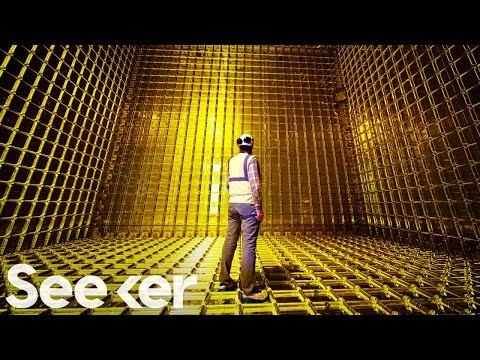
A calorimeter of far higher resolution must be built, capable of accurately separating the tracks of individual particles even in a dense environment — with more than about 6 million silicon sensor channels and hundreds of thousands of scintillator tiles arranged in 47–50 layers.
Research objective
To provide 5D information (space–time–energy) for the first time, enabling more precise particle identification and energy resolution.
Contribution of GTU researchers to the experiment
HGCAL is one of the largest and most ambitious upgrade projects of CMS. Institutes from many countries take part in the international collaboration (among them Fermilab, DESY and CERN test facilities); a Georgian surname (G. Adamov) appears among the authors of collaboration publications (for example the paper on the DAQ system), which confirms the involvement of Georgian researchers in this project, although this source does not specify separately whether the affiliation is with GTU or TSU.
According to the project description, GTU researchers are involved in the engineering design, testing and preparation of working drawings for HGCAL — including the complex mechanical and electronic integration (special copper cooling plates with CO₂-based cooling, front-end electronics, optical and electrical services).
Application potential
- More accurate recording of particle trajectories and energies in a high-density radiation environment
- Integration of high-density electronics and cooling systems, applicable to other high-radiation uses as well
- Use of machine learning algorithms to optimise data processing
Other research
CERN / CMS Collaboration
Scientific Results of the CMS Experiment and the Study of the Higgs Boson Properties