Rector Academician David Gurgenidze: GTU to Participate in Another Major CERN International Project
During his official visit to the European Organization for Nuclear Research (CERN) in Geneva, Rector of Georgian Technical University, Academician David Gurgenidze, signed a new Memorandum of Understanding with CERN entitled “Technical Contribution of Georgian Technical University to the CMS Phase II Upgrade Programme – LS3 (2026–2030)”. The agreement was also signed by Ursula Bassler, Director for International Relations at CERN; Giovanna Lehmann, Head of CERN’s Experimental Physics Department; and Professor Zviad Tsamalaidze, Director of the Institute of Quantum Physics and Engineering Technologies at GTU, Georgia’s Representative to CERN, and Head of the GTU CMS Research Group.
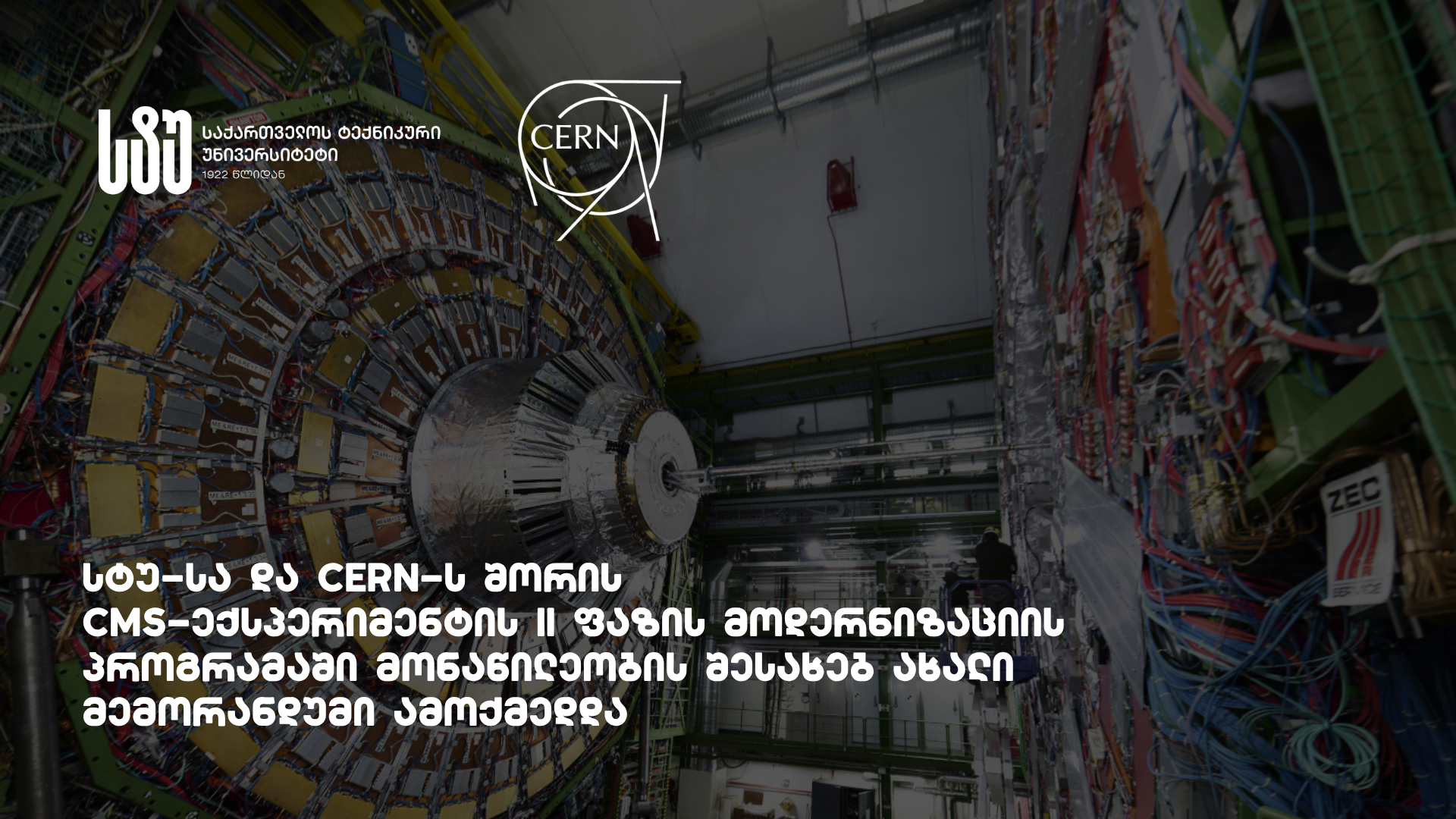
Under the agreement, engineers and technical specialists from Georgian Technical University will participate in the modernization of the CMS experiment at CERN between 2026 and 2030. Their work will include highly specialized engineering tasks involving mechanical systems, cabling, fibre-optic infrastructure, and other technical components. The CMS detector is one of the two largest general-purpose detectors at the Large Hadron Collider and played a central role in the discovery of the Higgs boson. The Phase II modernization program aims to prepare CMS for the High-Luminosity LHC era, when the experiment will receive ten times more data than in previous cycles.
According to the Rector, Georgian Technical University will establish and train specialized engineering teams that will work alongside international experts as part of the project.
Academician David Gurgenidze noted that the initiative will strengthen Georgia’s participation in world-class scientific infrastructure while further enhancing the country’s position within the global research community.
“This new stage of cooperation between Georgian Technical University and CERN is of exceptional importance both for our university and for Georgia’s scientific and technological ecosystem. The agreement enables us to participate directly in the large-scale CMS Phase II modernization program, one of the most significant international projects in modern experimental physics and engineering.
This renewed cooperation further demonstrates Georgian Technical University’s status as a trusted partner of CERN. Notably, the agreement extends beyond scientific collaboration by enabling Georgian engineers and technical specialists to play an active role in the modernization of the CMS detector. Our specialists will work with cutting-edge technologies, gain unique practical experience, and become part of an international scientific effort dedicated to expanding the fundamental knowledge of humanity.
This agreement is built upon the strong foundation established through many years of successful collaboration between Georgian Technical University and CERN. Our scientists have actively participated in international experiments, contributed to advances in high-energy physics, and earned the respect of the global scientific community through their professionalism and expertise. Today’s agreement underscores CERN’s strong confidence in our university and its researchers.
Modern scientific progress increasingly depends on the integration of physics, engineering, information technologies, and advanced technical solutions. Participation in the CMS Phase II Upgrade Program provides a unique opportunity to strengthen these interdisciplinary fields, expand our research capabilities, and further develop engineering expertise in accordance with international standards.
The involvement of young people is particularly important to us. I am confident that this partnership will inspire more students, young researchers, and engineers to become actively engaged in scientific research.
The agreement signed with CERN is another important step on the path of internationalization of Georgian Technical University, strengthening its scientific potential and expanding international partnerships. The cooperation will create many new opportunities, strengthen Georgia’s position in the global scientific space, and once again demonstrate Georgia’s intellectual and professional capabilities in the world scientific community. It is important that within the framework of the memorandum, scientists, engineers, and students of the Georgian Technical University – master’s and doctoral students – will be systematically involved in one of the largest engineering programs of CERN”.
– Academician David Gurgenidze
Related
News
Memorandum of Cooperation between GTU and the Land Transport Agency has been renewed
Vice-Rector of the Georgian Technical University, Professor Tamar Tsereteli and Director of the LEPL Land Transport Agency Bakur Mikadze signed...
Memorandum
Strategic Partnership Between GTU and the Official Representative of Carl Zeiss, AMK Management
The Georgian Technical University and AMK Management, the official representative of the global scientific technology company Carl Zeiss, have signed...
News
Memorandum Signed Between GTU and “Global Cell”
The Vice-Rector of the Georgian Technical University, Professor Tamar Tsereteli, and the Director of “Global Cell LLC”, Giorgi Maduashvili, signed...
Memorandum
GTU and “Regional Healthcare Center” Sign Cooperation Memorandum
Students of Georgian Technical University will soon have the opportunity to develop practical skills and gain professional and research experience...
Memorandum
Professor Alexander Taliashvili’s Funding Established for Outstanding Students
“It is gratifying that, from now on, talented and motivated students of the Georgian Technical University who win competitions with...
Memorandum
Signed Memorandum of Understanding between Georgian Technical University and the National Mineral Resources Agency
Vice-Rector of Georgian Technical University, Professor Tamar Tsereteli, and Head of the National Mineral Resources Agency of the Ministry of...