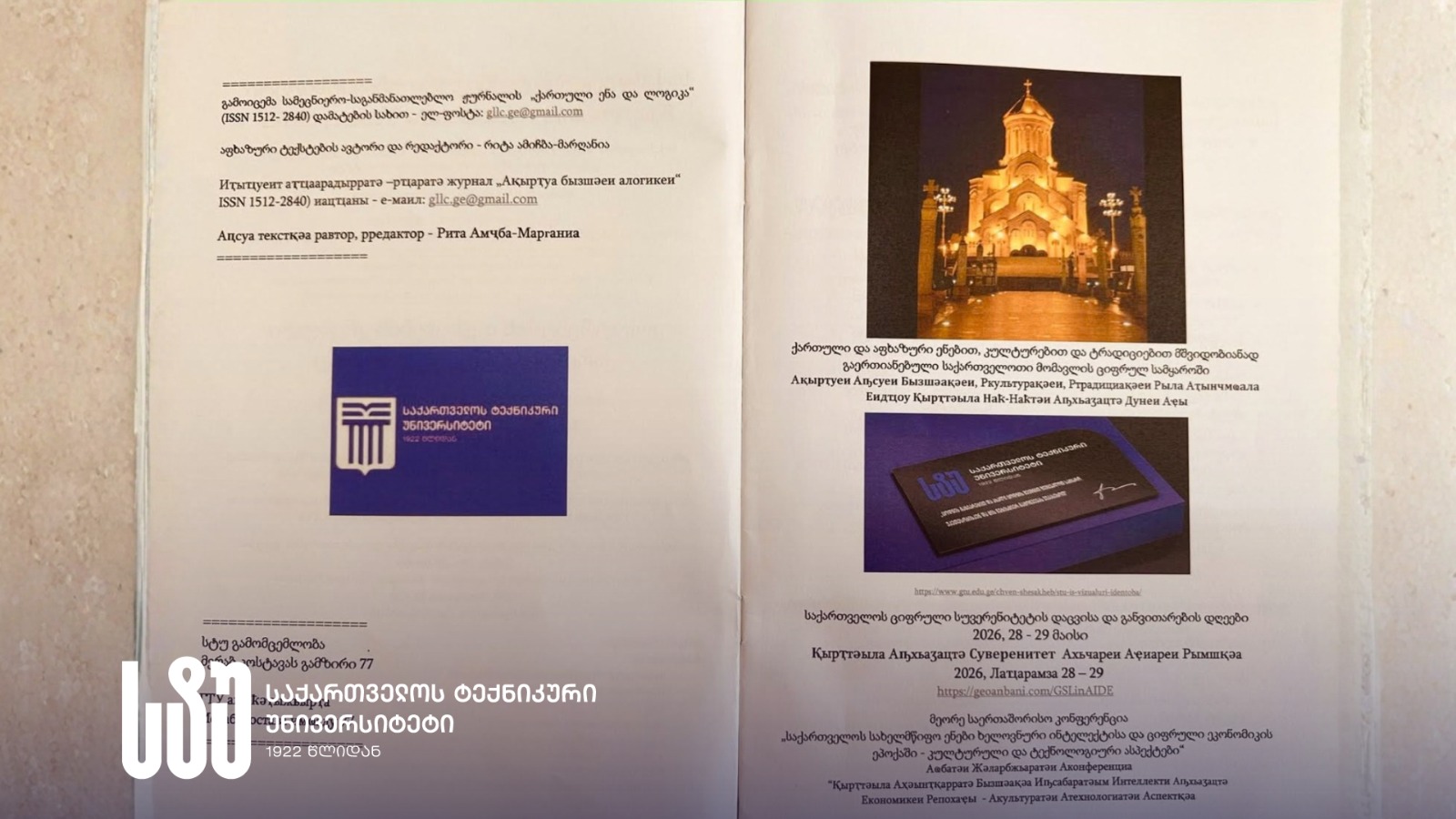
Georgian Technical University has published a collection of international conference theses in Georgian and Abkhazian languages
“For the first time, Georgian Technical University has created an opportunity to conduct scientific communication in Georgian and Abkhazian within the framework of an international conference and to publish the conference theses in both languages. For us, this initiative means more than creating a bilingual scientific publication; its significance is far broader. It reaffirms the university’s commitment to fostering scientific development and strengthening academic language, as well as creating a scientific environment where knowledge can be generated and shared within a multilingual, inclusive, and modern academic space. We believe this experience can serve as a foundation for new academic collaborations and represent a significant step forward in developing Georgian and Abkhazian scientific terminology, scientific communication, modern knowledge, in strengthening academic culture and creating a future where language serves as a living space for the advancement of science” – this was stated by Academician David Gurgenidze, Rector of the Georgian Technical University, at the presentation of the conference theses collection – published in both Georgian and Abkhazian – held within the framework of the second international conference titled “Georgia’s State Languages in the Era of Artificial Intelligence and the Digital Economy: Cultural and Technological Aspects.”
The bilingual edition is especially important from both scientific and cultural perspectives, as the collection presents 21 scientific topics that combine the modern challenges of state languages, the protection of their cultural heritage, technological development, and the creation and use of language resources in the age of artificial intelligence. The fact is particularly important that this is the first time an international scientific conference was held at the Georgian Technical University in Georgian and Abkhazian, and that a collection of theses was published in both languages.
According to Professor Konstantine Pkhakadze, Head of the GTU Scientific-Research Institute for the Cultural Preservation and Technological Development of Georgia’s State Languages, the publication of this bilingual collection can be regarded as a significant academic milestone in the field of the scientific and technological development of state languages; this is because the Georgian and Abkhaz languages are presented within a unified scientific space not merely as bearers of cultural heritage and linguistic identity, but also as instruments for the advancement of modern science and technology.
“In the context of modern technological development, language preservation is increasingly linked to digital presence. The advancement of artificial intelligence systems, large language models, machine translation, speech recognition and synthesis, search engines, and other digital technologies requires creating new types of resources for every language. Consequently, a language’s representation within the digital and technological landscape has become a crucial determinant of its vitality. With these challenges in mind, the Scientific-Research Institute for the Cultural Preservation and Technological Development of Georgia’s State Languages focuses on developing modern linguistic resources and technologies for the Georgian and Abkhazian languages.
The Institute’s research areas encompass natural language processing, the creation of linguistic resources, the application of artificial intelligence, technological support for the Georgian and Abkhaz languages, and the development of the corresponding scientific infrastructure. The publication of the conference’s bilingual collection of theses is a significant outcome of this very scientific process. This publication makes modern research related to the state languages accessible in both Georgian and Abkhaz, while simultaneously fostering the development of scientific terminology, linguistic resources, and technological fields.”
– Professor Konstantine Pkhakadze
According to the Rector of the Georgian Technical University, publishing a bilingual collection of theses is both an It is an academic experience and, at the same time, a clear message. In scientific dialogue and academic cooperation, the Georgian and Abkhaz languages must serve as full-fledged languages of modern science and technology. As Academician David Gurgenidze states, fostering the development of the Georgian and Abkhaz languages in the scientific sphere means strengthening the capacity for knowledge creation and academic activity among future generations.
“With this initiative, the Georgian Technical University once again underscores its distinctive mission: to create an academic environment where science generates new knowledge, education unlocks new opportunities, and academic collaboration strengthens scientific ties and fosters a shared scientific space. Furthermore, the University considers it its responsibility to promote the development of the Georgian and Abkhazian languages as languages of modern science and technology. The twenty-one scientific topics compiled in this volume highlight the multidisciplinary context in which issues concerning state languages are addressed today. In the modern era, language is no longer merely a means of communication; it constitutes digital data, a repository of knowledge, an object of technological processing, and a crucial component of artificial intelligence systems.
In this context, fully integrating the Georgian and Abkhaz languages into the digital space depends on developing resources such as electronic corpora, digital dictionaries, terminology databases, linguistic datasets, automated translation systems, and natural language processing technologies. Given this necessity and the importance to the state, the government’s attention and commitment to the development of the Georgian and Abkhaz languages – and to establishing their presence within the modern scientific and technological landscape – are particularly praiseworthy. The establishment of the Institute – realized through the initiative of the Prime Minister of Georgia, Irakli Kobakhidze, and with the support of the Ministry of Education, Science and Youth of Georgia – is a direct result of this vision and support; for this, we extend our profound gratitude to the state.”
– Academician David Gurgenidze
The collection of theses includes works by researchers from the Georgian Technical University, Ivane Javakhishvili Tbilisi State University, International Black Sea University, Georgian National University (SEU), Kutaisi International University, the University of Illinois, and the GTU Scientific-Research Institute for the Cultural Protection and Technological Development of Georgian State Languages – specifically: Konstantine Pkhakadze, Shalva Malidze, David Gegia, Bidzina Lemonjava, Aleksandre Maskharashvili, Gela Lobjanidze, Gocha Nanitashvili, Lali Tibua, Lia Kurtanidze, Merihan Hazem Anwar Labib Bishara, Merium Hazem Anwar Labib Bishara, Rati Skhirtladze, Leila Avidzba, Natia Poniava, Mikheil Rukhaia, Nino Gegenava, Elene Kutateladze, Mariam Katamashvili, Demetre Labadze, Luka Pkhakadze, Rita Marghania, and Besik Dundua – including the paper: “Pyrolog: Extending Prolog with Rule-Based Inference”; “Georgian-Abkhazian Dynamic Terminological Portal: Objectives, Concept, and Methods”; “Objectives, Challenges, Results, and Recommendations Regarding the Comprehensive Mathematical Study and Technological Support of the Georgian and Abkhazian Languages”; “Establishing and Implementing a Three-Tier Educational Program in Logic, Language, Artificial Intelligence, and Knowledge Engineering as the Primary Objective of Our Institute for This Stage”; “Reasons for the establishment and immediate objectives of the GTU Scientific-Research Institute for the Cultural Preservation and Technological Development of Georgia’s State Languages”; “Trends and prospects of the digital economy in strengthening state sovereignty”; “Application of TSR logic methods”; “An interpretable fuzzy logic-based model for assessing electromagnetic risks in an urban environment”; “Bridging theory and practice: Scalable probabilistic ILP for real-world artificial intelligence”; “From Bayesian sorting to unclassified probabilities: A scientific path toward human-like artificial intelligence”; “The role of digital technologies in the process of teaching the Abkhaz language”; “Application of Urang-style probabilistic logic to understanding natural language ambiguity”; “The first mathematical analysis of the Abkhaz simple sentence based on Shalva Pkhakadze’s theory of notation and Konstantine Pkhakadze’s logical grammar of the Georgian language”; “The Logical Grammar of the Georgian Language as the Basis of Georgian Language Logic”; “Application of Theories from Philosophers of Language to Translation Practice”; “The Issue of Artificial Intelligence from the Perspective of the History of Western Philosophy”; “Generation of Regular Languages Based on the Relation of Similarity”; “Formal Modeling of a Drone Swarms”; “The Georgian Self-Developing Corpus and an Overview of the Embedded Systems for Morphological, Syntactic, and Logical Analysis of Georgian Texts”; “The Abkhaz Self-Developing Corpus and the Objectives and Methods for Developing the Embedded Abkhaz Orthography System”.
Related

News
TUDA Idea Competition for Local and International Students: “A Neighbourhood Tailored to You!”
The Tbilisi Transport and Urban Development Agency (TUDA) announces the idea competition "A Neighbourhood Tailored to You! – Idea Competition...
News
UNI4VERSE FINEDU Information Session at GTU
GITA’s university competition gives students the chance to create innovative prototypes in financial education and technology and to travel to...
News
The Professor Vidas Kavaliauskas Lithuanian Language and Culture Center Offers Lithuanian Language Courses to Students
The Professor Vidas Kavaliauskas Lithuanian Language and Culture Center, at Georgian Technical University, invites GTU students to study Lithuanian. The...
News
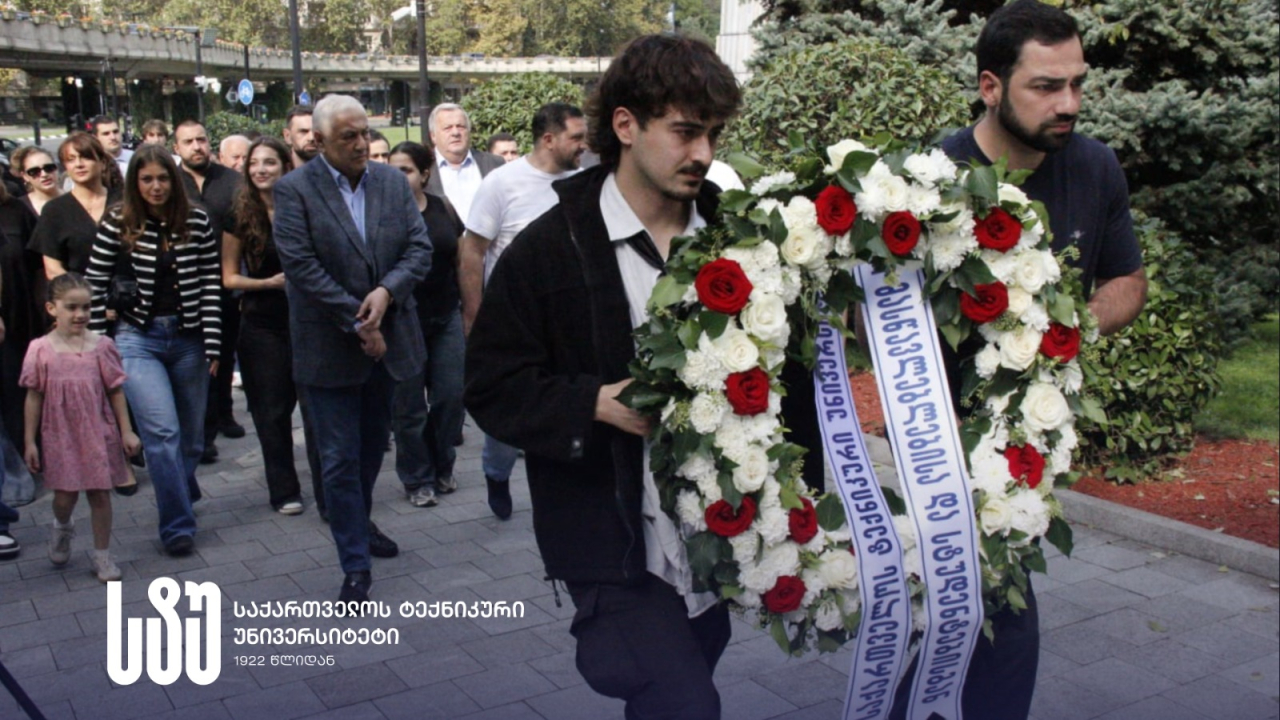
GTU Rector – “We Must Not Forget Abkhazia, We Must Not Forget Those Who Lost Their Lives and the Veterans, and We Must Not Forget the Pain of Displaced Families”
“The imposed conflict and the war in Abkhazia left the country with an extremely painful legacy – immense loss of...
News
Tbilisi City Hall Opens Applications for the Student Funding Program
Tbilisi City Hall has announced the opening of applications for the Student Funding Program, which provides financial assistance to students...
News
The Rector of GTU Presented Distinguished Employees with Gold Medals and Honorary Diplomas
The Rector of Georgian Technical University (GTU), Academician David Gurgenidze, presented honorary awards to university employees by decision of the...